



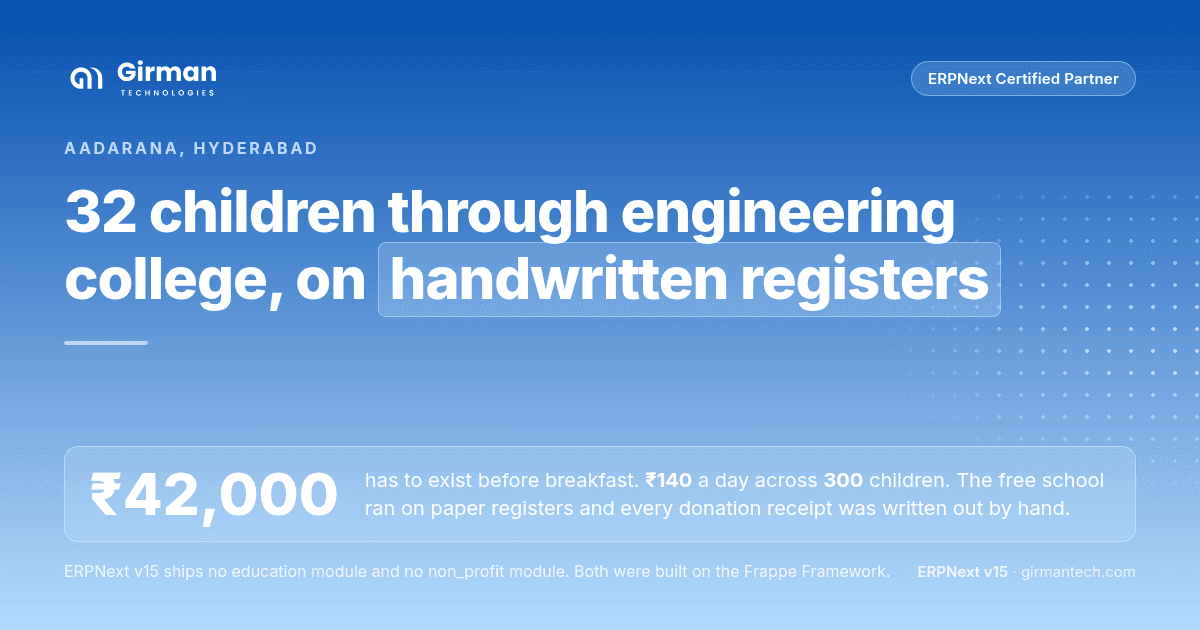
Thirty-two engineers.
One of them at IIT (ISM) Dhanbad. Alumni working in four countries.
Every one of them arrived in Saroor Nagar, Hyderabad, with nothing.
Aadarana has taken in more than 7,000 children since 2003, orphaned, needy and underprivileged. It feeds them three times a day. It checks their health every month and sends them to a specialist when the check-up finds something. It teaches them karate, classical dance and music. In 2025-26 it put a class in front of the SSC board and every single candidate passed. Then it pays for college, and mentors them through it.
Three hundred children live there today. Two hundred boys, one hundred girls.
In 2024, if you walked in and asked for a list of the students in Aadarana's own school, somebody walked to a shelf and opened a register.
Rs 42,000 before breakfast
One child costs Rs 140 a day. Food, school, healthcare. A single meal costs Rs 5.
Three hundred children.
So Rs 42,000 has to exist before breakfast. Every morning. Three hundred and sixty-five of them a year, which is roughly Rs 1.5 crore, raised from people who owe Aadarana nothing and can stop whenever they like.
Those are Aadarana's own published figures, and they agree with each other. The organisation also publishes Rs 50,000 as the cost of complete care for one child for one year. Across 300 children that is the same Rs 1.5 crore, reached by a different route.
No endowment. No government cheque. Fundraising teams in three cities, going out to ask, every month, forever.
And Aadarana is not one organisation. It is three wearing one name.
A home. Residential care for 300+ children, with monthly check-ups, specialist referrals, sports and a computer lab.
A school. Amitabha Aadarana Vidyalaya, on campus since 2017. English medium, co-educational, Classes 1 to 10, 15+ qualified teachers, 3,000+ books in the library. Free for every resident child, and open to needy day scholars from the streets around it.
A fundraising operation. Bangalore, Hyderabad and Delhi, reporting into the head office in Hyderabad.
One campus. The same three hundred children. Not one shared system between them.
The 7 a.m. problem
A teacher opens a register and writes names.
Classes 1 to 10, every morning. Paper is reliable. Paper never goes down. Paper is also silent, and it answers nothing you did not already know.
At 153 students across roughly 220 school days, that is in the region of 33,000 attendance marks a year in longhand, and not one of them a question anyone could ask. How many days had a child missed this term? Flip pages and find out. Give it an afternoon.
A child's whole record worked the same way. Admission, class, section, marks, all in handwriting, in a book, on a shelf.
One copy.
A school that had just recorded a 100% board pass rate held the only proof of how it did it in a stack of paper in one room in Hyderabad. No backup. No second site. One fire, one flood, one register left on a bus.
"Every rupee tracked"
That is Aadarana's promise to donors. Three words, on its own website.
It is the right promise. Programmes can be described. Outcomes can be photographed. Trust has to be proved, in numbers, the moment somebody asks.
Aadarana was keeping it from memory.
Who gave. How much. When they last gave. Whether they had ever given before. All of it in people's heads and in notes scattered across three cities. Ask what the Bangalore team raised last quarter and you got an estimate. Ask what one donor had given across three years and you got a phone call and an afternoon.
And every receipt was made by hand.
A donor gives Rs 8,000. Someone on the fundraising team stops raising money, sits down, and writes out a receipt. Then does it again for the next one. And again.
That work brings in nothing. It feeds no one. It is friction between a person's generosity and their proof that it landed, and the hours went onto the same bill as the Rs 42,000.
The brief was three sentences long. Computerise it. Automate it. Put it somewhere it cannot be lost.
Why ERPNext has nothing to configure for a school or an NGO
This is the part most write-ups get wrong, so it is worth stating precisely.
ERPNext v15 does not ship an education module. It does not ship a non-profit module either. The module tree on the version-15 branch runs accounts, assets, bulk_transaction, buying, crm, manufacturing, projects, selling, stock, subcontracting, support and a handful of infrastructure directories. There is no education. There is no non_profit.
Both were separated out of core. Frappe said so itself in issue 29151 on the ERPNext repository: "We are moving Non Profit domain in to a separate app."
The donor and donation doctypes went with it. They live in frappe/non_profit, alongside donor_type, member, membership, chapter, volunteer, grant_application and tax_exemption_80g_certificate. That app is archived. Its last commit landed on 12 July 2024.
So for an organisation that needed a school module and donor management, the Frappe ecosystem offered one unmaintained app covering half the requirement and nothing at all covering the other half.
School management and donor management were therefore built as custom doctypes on the Frappe Framework, with ERPNext underneath for the accounting. Not configured. Built. That was not a stylistic preference about bespoke software. On v15 it was the supported path.
Why one system instead of two
The platform settled how. The organisation settled why.
Aadarana is a school and a three-city fundraising operation sharing one staff, one board and one campus. Every packaged option on the table understood exactly one half of that.
A school ERP would have run Classes 1 to 10 and never heard of a corporate donor in Delhi. A fundraising CRM would have tracked the donor and never heard of Class 7 Section B. Buying both would have delivered two logins, two databases, the same reconciliation problem Aadarana already had, and a licence fee on top of it.
One system, where a child's attendance and a donor's giving history sit in the same database.
The Frappe Framework supplied everything identical at every organisation on earth: users, roles, permissions, reports, email, print formats and cloud hosting. The custom work went only where Aadarana is genuinely unlike anyone else.
Ten to fifteen people use it. The teachers, and the fundraisers.
What 7 a.m. looks like now
Classes up to Class 10 are defined in the system, with the subjects each one teaches. A digital student form replaced the admission register, so every child is entered once and held centrally. 153 students are registered today, which is Aadarana's resident children plus the day scholars from the neighbourhood who attend the free school.
Attendance is five steps on one screen. Class. Section. Academic year. Fetch students. Mark them.
That is the whole morning.
No register. No evening transcription. No second copy disagreeing with the first. The record is made by the woman who watched it happen, at the moment she watched it, and from that second it is something you can interrogate.
Thirty-three thousand strokes of a pen became a tap.
Examinations and report cards run on the same module, so a child's marks sit beside her attendance and her admission file instead of in a different book on a different shelf. And the list of registered students, the one that used to need a walk to a shelf, is a report.
The receipt that writes itself
Donation receipts are now generated by the system and emailed to the donor.
One sentence, and it is the highest-return change in the engagement.
The handmade receipt is gone. Those hours went back to the only team in Aadarana whose time turns into funding. And the donor gets proof immediately instead of eventually, which matters more than it sounds: a donor thanked on the day is a donor who gives again next year.
Underneath it sits the record-keeping that makes it work. A Donor doctype holds each donor as Individual or Corporate. Full name and phone number are mandatory, and the rest fills in as Aadarana learns it. Donors can be created from several screens through quick links, so whoever meets the donor enters the donor. No handoff. No shoebox of business cards waiting to be typed up.
Donations post against that donor. Search a name and four things come back that never existed before: total amount given, number of donations, first donation date, last donation date.
In the live system, one record showed Rs 6,000 given. Another Rs 8,000. Another Rs 16,000, each with its full history behind it.
Which changes what a meeting is. A fundraiser in Bangalore now walks in knowing exactly what the person across the table has already done for three hundred children in Hyderabad, before either of them says hello.
What can Aadarana see now that it couldn't before?
Teams are records too. Each of Aadarana's fundraising teams holds its own data, which makes two questions answerable for the first time.
What has each team raised? One report. Bangalore, Hyderabad and Delhi, side by side.
What has one donor given, in total, ever? One search.
Every donation now carries a donor, a date and a team, which closes the loopholes that paper-based donation tracking leaves open by design.
For a non-profit raising Rs 1.5 crore a year across three cities, that is how you decide where next quarter's effort goes. It is also how you tell a corporate donor what their money did, in figures instead of adjectives.
"Every rupee tracked" stopped being a promise and became a query.
The birthday message
WhatsApp was wired into donor communication. The live use is birthday greetings.
A date on a donor's record. A message on the morning.
It reads like a nicety. A receipt tells a donor their money arrived. A birthday message tells them the people they fund know who they are. Aadarana survives on individuals choosing, year after year, to give again, and the whole of fundraising is remembering people properly.
One honest limitation
Building custom on the Frappe Framework bought a system shaped to Aadarana. It also bought the maintenance of that shape.
A packaged school ERP gets board-exam format changes, new statutory report layouts and compliance updates from its vendor, pushed to every customer. Aadarana's school module does not. When the SSC report card format changes, somebody has to change it. That is a real, recurring obligation, and it sits with Aadarana and whoever maintains the system rather than with a product roadmap.
The trade was taken deliberately, because the alternative on ERPNext v15 was an archived app plus a second product that could not see the donors. But a non-profit weighing the same decision should price the upkeep, not just the build.
The second limitation is narrower and worth naming. The headline reduction in manual effort, 70 to 80%, is the estimate of the engineer who built the system. It is not a figure Aadarana measured. A counted number, receipts issued per month or hours per week returned to the fundraising team, would be worth more than a larger uncounted one.
Results
- 153 students moved from paper registers to centralised digital records
- Roughly 33,000 handwritten attendance marks a year replaced by a five-step screen flow for Classes 1 to 10
- Donation receipts moved from handwritten, one at a time to generated and emailed automatically
- Donor records now return total given, donation count, first donation date and last donation date on a name search
- Team-wise fundraising reporting across three cities, Bangalore, Hyderabad and Delhi, where there was none
- 10 to 15 users on one system: teachers and fundraising team
- WhatsApp birthday greetings live for donor communication
- Single paper copy replaced by secured cloud hosting
- 70 to 80% reduction in manual effort, as estimated by the engineer who built it
Why ERPNext
Not because it had a module for this. It did not, and that is the whole point of the section above.
ERPNext gave Aadarana a working accounting foundation, and the Frappe Framework gave it users, roles, permissions, reports, email, print formats and hosting without any of that being written. What remained to build was the part that is actually specific to a children's home running a free school and a three-city fundraising team: the student record, the attendance flow, the donor, the donation, the receipt.
An organisation at Aadarana's scale cannot fund a system built from nothing, and cannot operate inside a rigid one that only understands half of what it does. That combination is the reason this worked.
Frequently asked questions
Does ERPNext have a non-profit or donation management module?
Not in v15 core. The non-profit domain was separated into its own app, which Frappe stated in ERPNext issue 29151. The donor, donation, donor_type, membership and tax_exemption_80g_certificate doctypes live in the frappe/non_profit repository, which is archived with a last commit of 12 July 2024. A current implementation means either reviving that app or building the doctypes on the Frappe Framework.
Does ERPNext have a school or education module?
Not in v15 core. Like the non-profit domain, education was separated out of ERPNext. The version-15 module tree contains no education directory, so school management on a current ERPNext release is custom work on the Frappe Framework rather than configuration.
Can one Frappe instance run both a school and a fundraising operation?
Yes, and that is the argument for doing it this way. Holding student records and donor records in one database means a child's attendance and a donor's giving history are queryable together, rather than reconciled by hand between a school product and a CRM.
How do you issue donation receipts automatically in ERPNext?
Generate the receipt from the donation record using a Print Format, then send it by email from the same record. The receipt and the accounting entry stay bound to one object, so there is no separate step in which a receipt can be forgotten.
What is the catch with building custom doctypes instead of buying packaged software?
Upkeep. A vendor ships format and compliance changes to every customer. A custom module does not. When a board-exam report card format changes, somebody has to change it. The trade is worth making when no packaged option covers the organisation's actual shape, but the maintenance is a real recurring cost and should be priced.
Can Frappe send WhatsApp messages to donors on their birthday?
Yes. With the birthday held as a date field on the donor record, a WhatsApp integration can send on the day. For an organisation funded by repeat individual giving, this is a retention mechanism rather than a courtesy.